


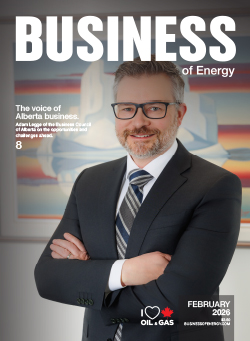
Adam Legge is optimistic about Alberta’s future but somewhat worried about the future of Canada as a prosperous and vibrant nation. As president of the Business Council of Alberta, Legge is the eye, ear and voice of Alberta’s business community – and though he sees and hears a lot of positive things, he cautions about potential missed opportunities. Alberta, he believes, has a lot going for it, so long as the moment is grasped.
“Alberta has so much of what the world needs,” Legge says from the BCA offices in downtown Calgary. “Whether it’s energy, food, critical minerals, forestry products, artificial intelligence, skilled people. I can’t think of a place that has more of what the world needs than Alberta.
“But can we as a country meet the urgency of the moment?” he continues. “Can we tackle some of the longstanding barriers? This time last year, the country was united in working together to deal with threats from the U.S. We were talking about dropping interprovincial trade barriers, buying Canadian, one Canadian economy. But as some of the trade threat has subsided, we’ve seen many go back to their corners and some provinces advocate for conflicting positions.”
The million-dollar question remains: will we actually build national energy projects? Will we see projects approved and built quickly enough to capitalize on the needs of the world?
“What worries me is we will go back to sleep on the urgency of the moment and miss the window on everything from natural resources to defense to artificial intelligence,” he warns. “We need to keep a sense of urgency, followed by action.”
Thus is one raison d’être for the BCA: be the voice of the province’s top business leaders to drive and push practical solutions for prosperity in Alberta and Canada.
Launched in 2019 with five founders – Ron Mannix, Mac Van Wielingen, Nancy Southern, Dawn Farrell, Hal Kvisle – the BCA was formed to provide a unique private sector voice for provincial and federal policy. The initial membership included 20 companies. Legge, whose previous role was CEO of the Calgary Chamber from 2010 to 2017, was tapped to lead it.
Today there are 142 member CEOs that form the council, and their companies range from oil and gas, real estate, construction, technology and telecom, agriculture, financial services, manufacturing, aviation and aerospace. “We’ve got members in Calgary, Edmonton, Red Deer, Medicine Hat and Fort McMurray,” Legge notes. “We’re in great shape starting our seventh year.”
At the BCA Legge’s role spans three interconnected areas that reflect the Council’s CEO-led model. “One is member engagement, to understand our members’ business priorities and challenges,” Legge explains. “I bring that back and work with the team to develop policy solutions or to create opportunities. Third is working with government to address those challenges and opportunities at a policy or legislative level.”
Legge and the team of 10 at the Business Council engage with the 142 members (and the larger business community) in a variety of ways: direct engagement, at member meetings three times per year, member surveys and informal communication. “We’re constantly scanning the external environment to find the common issues,” he says. “We don’t advocate for any specific vertical industry. We’re more macro, big-picture, long-term strategic business environment advocacy.”
Once an issue or project is identified, a task force of roughly 10 to 14 members is assembled to guide the BCA’s work in that area. “They’ll help us understand the issue, propose solutions, and turn that into something that we can deliver to government and the public,” he says.
The Business Council produces major taskforce reports a few times per year, as well as smaller analysis pieces throughout the year. Its podcast is primarily centred around C-Suite Unplugged, where CEO members tell their story. The BCA also plays an active role in shaping discourse – engaging media and stakeholders to advance evidence-based policy ideas and content and respond to emerging economic and policy developments.
Successful advocacy at the provincial and federal levels is due to deep understanding of Alberta’s economic environment and the BCA’s relationships at all levels of government. “On the federal side, we’re part of a chorus of voices with respect to things like scrapping the emissions cap or dealing with the clean electric regulations,” Legge continues. “Particularly in the regulatory reform space, we’ve had a significant impact on the evolving improvements in Canada and are continuing to push for regulatory reform to ensure efficiency and ability to help attract investment.”
On energy, Legge is encouraged by the MOU signed in November between the federal government and Alberta. “It was a sea change in the tone of the relationship,” he opines. “Alberta has long been victim to biased public policy against our primary industries of oil and gas, agriculture and resource industries. I applaud Premier Smith and her push to get this agreement done. To see a Prime Minister agree to a deal that has the potential to enable Alberta to grow its oil and gas production, get a pipeline to the West Coast and access new markets, is something we couldn’t have imagined a year ago.”
While there is optimism, Legge points to a number of things that still need to happen: “We need to agree on a carbon price structure. We need to continue to fix the regulatory approval system, address the tanker ban, and work with B.C. and Indigenous communities to get agreement on a project. While it’s positive, we need to see more things happen to drive investment.”
This requires Alberta to keep the pressure on and the momentum going so that we can get projects built.
“Our members are very keen to see the MOU continue in its spirit, setting a positive tone for 2026 that hopefully results in a West Coast solution for a new pipeline,” Legge says.
On pipelines, Legge sees much opportunity: “Alberta has the ability to supply pipelines in pretty much every direction. There’s more demand in the U.S., so a resurrection of Keystone XL or additional capacity to the U.S. is a viable option. The West Coast is clearly a priority for our members and the provincial government. There’s more demand for our energy across this country so the dream of something like an Energy East makes total sense. There are also opportunities to ship into the Arctic, whether it’s Churchill, Manitoba or Grays Bay, Nunavut.”
The LNG opportunity could allow Canada to help other countries to get off higher carbon intense fuels like coal. Legge notes we are 10 years behind some of the build out in places like the U.S., Qatar and Australia, but we can still catch up given the long-term global demand.
“Continued investments in LNG will serve Canada well over the long term and frankly, help reduce global emissions,” he points out. “You look at places like India that continue to grow at a rapid rate, it needs our LNG.”
A fully scrapped or greatly modified Bill C-69 is needed to create greater certainty, reduce timelines and political interference in major energy project development. “Companies need certainty and protection from unwarranted holdups or legal challenges that kill any sense of Canada being a good place to invest in,” Legge urges. “We’re now talking about Canada wanting to build and be credible nation. I think the world is watching to see if we can meet the rhetoric with performance.”
Provinces like Quebec (where the Ford F-150 is the bestselling vehicle) and B.C. (which has a struggling economy) will, Legge suggests, hopefully see the light when it comes to the benefits of Alberta’s energy: “Quebecers actually do support Canadian energy production. In B.C., hopefully the Premier will recognize a greater balance is needed between the environment and the economy, and he’ll support projects that will enable job creation and investment to flow in incredible levels into his province.”
“There’s tremendous importance in engaging with Indigenous communities all along the resource project pathway and creating long-term economic benefits for them,” he adds. “It’s important to get the perspective of those impacted by a major project and to filter out the noise of those who won’t be.”