


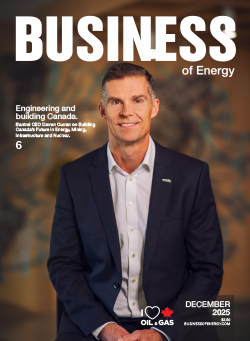
Forty-two years ago, Bantrel was formed as a small engineering firm to pursue offshore oil and gas projects in Eastern Canada. The original shareholders included Trimac, owned by Calgary’s well-known McCaig family, and Bechtel Corporation, a large, family-led global EPC company. Though the Hibernia pursuit never panned out, Bantrel certainly did.
Today, it is a leading engineering, procurement and construction (EPC) firm in Canada, still backed by Bechtel and McCaig P&C Holdings Ltd. With nearly 1,000 staff spread across the country, Bantrel specializes in end-to-end solutions for some of the most complex projects across multiple industries.
“It’s an exciting time for Canada and for Bantrel,” confirms president and CEO Darren Curran. “One of the most exciting things is how we’ve purposefully and strategically moved into new markets over the past decade. We planted those seeds and they took time – we watered and grew them – and now we’re seeing the fruits of that, particularly in the last five years, especially coming out of COVID.”
Bantrel’s roots are in Alberta oil and gas, where the company grew rapidly throughout the 1980s and 1990s. “We started with a handful of people and a lot of ambition,” Curran, who is a mechanical engineer by trade, recounts. “With the opening and then boom of the oil sands and heavy oil upgraders, we went through an inflection point where we grew rapidly. There was such a demand for everything that people got stretched and formed. It was an opportunity for Bantrel to go from an engineering company to a construction company.”
Clients, Curran explains, needed capacity and were willing to invest in Bantrel because they knew and trusted the company. “Some of it is good timing,” he admits, “but we’ve stuck with it and developed the full EPC business. We can provide that complete range of services to our clients today.”
This is Curran’s second go-around at Bantrel. His first was as a young project engineer in the mid 1990s.
After graduating from the University of Calgary amid one of the oil and gas industry’s downturns, he went to Saskatchewan to find work. “I was working at the Coop refinery in Regina and a friend of mine had moved to Calgary and got a job at Bantrel,” he recounts. “He said: ‘You have to come to this company, it’s growing like crazy. There is so much opportunity.’ So I came here. I was a young engineer and I got to do a lot of neat things. I also met my wife at Bantrel, she was a chemical engineer at the time.”
Though he loved his job, Curran yearned to work overseas, a dream he’d had for years. He took an opportunity to leave Bantrel and spent a decade working on major projects in Texas, Korea, China and Western Canada.
Curran and his wife decided to return home to start a family and work with Canadian energy companies. Having maintained a strong connection with Bantrel over the years, he was presented with an opportunity to lead the company seven years ago.
“I met the board, the COO and CEOs of Bechtel and Jeff [McCaig] (chair of the board),” he recalls. “We went through a lot of discussions on what they were looking for and how I could provide that leadership. In 2018 I joined Bantrel again. Sometimes it feels like I joined just yesterday, other days it feels like I’ve been here forever!”
“I’m so proud to know Jeff,” Curran continues. “The mentoring and wisdom he shares freely and his community service is so valuable. He was present (as a university student) when his father signed the original partnership agreement to form Bantrel. He’s been our chairman for two decades and still has such a passion for our business, curiosity and an entrepreneurial spirit.”
The continuous involvement of Bantrel’s two current shareholders since the beginning is an advantage: “The commitment of Bechtel (also a family-led business) and the McCaig family has been foundational. I count my blessings on being a private company rather than a public one. We are blessed with have long-range thinking, and we’re not driven by quarterly results and analysts. We get a lot of support from our shareholders and the patience to weather challenges.”
Today, Bantrel’s traditional energy markets extends beyond oil and gas production and processing to carbon capture, mining, infrastructure, nuclear and other industrial installations. “We’ve diversified into other markets and different clients throughout the rest of Canada,” Curran explains. “The purpose is to dampen commodity cycles. All oil and gas left us subject to the ups and downs of commodity prices. That’s hard because it can result in rapid growth or contraction.”
Nuclear, part of the burgeoning net-zero electricity market, is a business Bantrel is looking to grow. “Our electrical grids are challenged with intermittent power from renewable sources,” Curran notes. “They don’t work when the sun’s not shining and the wind’s not blowing. Natural gas bridges the gap but nuclear is the answer. There is so much forecast growth. It is really exciting.”
With barriers to entry to nuclear, including regulatory certifications, Bantrel has invested in this area. “We’ve spent significant money and time getting over those barriers,” Curran says. “The other differentiator for us is Bechtel, our parent company, who has done the most recent commercial nuclear in the western world with global EPC expertise. We see a great future market and it’s something our people want to work on.”
While relatively evenly diversified across primary markets, the largest portion of Bantel’s business today is in mining work. “Canada has so much potential in mining,” he notes. “Infrastructure has been an exciting area for us too, driven by significant investment across Canada to catch up to years of underdevelopment.”
The types and sizes of projects Bantrel takes on run the gamut from really large (in the billions of dollars) to small (hundreds of thousands of dollars). “Very little of our work is cookie cutter or pure replication work,” Curran explains. “Each project has its own unique challenges and needs. Common themes are concrete, steel, pipe, equipment, power and controls. Lots of interfaces to coordinate and plan to make it all fit together.”
Mega-projects include pipelines, oilsands, upgraders, refineries, carbon capture in the energy space, smelters, mills, potash in the mining space and light rail in the infrastructure market. Current projects include clients such as BHP, Cabot, Cenovus, FCL, Fortis, Keyera, HTEC, K+S Potash, Imperial Oil, Metrolinx, PRGT, Suncor, WIPP and various municipalities.
How much of the business is focused on engineering, procurement or construction at any given time really depends on the lifecycle of a project. “It ebbs and flows,” Curran explains. “Project development is iterative. It goes ahead to a point, gets a decision, then goes ahead to the next point, with a feedback loop.”
For example, the company is currently working on two large potash projects in Saskatchewan, one of which has been ongoing since 2017. “We went through three years of engineering and procurement iterations to get to funding approval and now are well into heavy construction,” he says. “So some of the engineers moved on to other projects while others flowed to the construction team.”
Bantrel also does small projects, for two reasons: smaller projects have shorter schedules which help weather the boom-and-bust cycle large mega-projects can create, and they foster the long-term relationships Bantrel has with its clients by providing steady work.
“As an example, we’ve worked for 35 years at the Imperial Strathcona Refinery,” Curran notes. “We have a very good long-term relationship there. We might replace a piece of pipe, a few valves or we might debottleneck significant part of the plant.”
The company prefers to provide the engineering, procurement and construction services through a given project: “We like it best when we can be accountable from start to finish, a single point of trust for our clients. Plus we learn and develop by seeing it all the way through.”
Sometimes clients prefer to have different contractors provide engineering and procurement, construction management or construction resources. “Many times we will provide EPCM where we do the engineering, the procurement and the construction management, and then we bridge the gap to the construction contractor,” he says.
Innovation and technology are embedded in Bantrel’s services. This includes software focused on engineering design, efficient collaboration between engineers and manufacturers, and virtual reality to allow clients to experience the design plan in 3D before it is built to plan, and through construction to optimize cost, schedule and safety.
On the procurement side, Bantrel benefits from the $18 billion annual spend by Bechtel. “It buys us leverage,” Curran points out. “Particularly over schedules. Some of the stuff we buy, like transformers, compressors or turbines, can take two to three years to arrive. So to have the leverage of our parent company to pull on as needed is a huge advantage.”
With offices in Calgary, Edmonton, Toronto and recently Saskatoon, Bantrel fosters a cohesive culture that starts with the company’s mission and values. “We actually hire, promote and live according to them,” Curran says. “I think that’s the hard part and we’ve made really good strides in it.”
“One thing we’re really good at is remote, complex construction work,” he continues. “A lot of the time that is camp-based work. A temporary location. There are always some local talent and we try and max out our local impact and hires. But to get the work done, many of our construction people commute from other locations on some kind of rotation to different locations across Canada.”
When it comes to sustainability, Bantrel aims to be authentic and focus on things it can control, like how people get to work and how much energy use and waste there is.
“In our designs we consider things that are also key for our clients, like how can we use less water, how can we electrify temporary and permanent equipment, how to contain or reuse emissions and energy – really practical things,” Curran says.
A focus on the community means Bantrel matches employee donations to causes they support, encourages volunteering and supports local events.
Looking forward, Curran is optimistic for both Bantrel and the country, though a little cautious as well: “It feels like we’re at this inflection point where we’ve had 12+ years of stalled projects, regulatory uncertainty, companies spending billions of dollars to get nowhere, and that’s not sustainable. But now the different levels of provincial and federal governments, and citizens themselves, are saying: ok, maybe the economy has to be the first priority so we can pay for all the things we want like schools, healthcare and social supports. There’s a lot of great talk right now – it just needs to become action.”
“It’s an opportunity that we all have – not just for ourselves or our businesses – but to give back to society,” he concludes. “That’s what I really hope for. I’m looking forward to my kids and their careers and what’s ahead of them.”